Some guided tours fill up so quickly that they disappear from the program right away. That’s exactly what happened with the guided tour of the historic Prochaska Printing House building in the center of Český Těšín, which the ČteFesT festival included in its program this year.

Interest exceeded the expectations of both the organizers and FINIDR itself. People didn’t just want to see an old building. They wanted to delve into the story of the place where the printing history of the Cieszyn region began more than two centuries ago. And perhaps also to find out what actually happened to the legendary printing house…
“We’re a printing house that focuses on printing books. That topic is naturally close to our hearts. At the same time, we’ve long been selecting projects we want to support, and ČteFesT made sense to us from the very beginning,” explains Kateřina Misiarzová of FINIDR.
It was a meeting with festival director Marika Zadembská and Dana Zipserová, director of the Municipal Library in Český Těšín, that sparked the idea that ultimately took visitors to a place they wouldn’t normally get to see.
“One thing led to another. The owner, Jaroslav Drahoš, was enthusiastic about the idea and offered on his own that part of the program could take place in the historic Prochaska Printing House building,” recalls Kateřina Misiarzová.
A Journey Through Time from the Rotary Press to “Hell”
Ondřej Prokop and his colleagues also guided the visitors. And this was no ordinary tour.
It began in the present—with the machines that today produce books for customers across Europe. Then the groups gradually moved on to the places where the history of printing in the Cieszyn region began.
“We wanted to show people not only the historical sites, but also the contrast between the past and the present. They walked with us through all three floors of the building and saw the spaces where printing took place as early as the beginning of the 19th century,” says Ondřej Prokop.

It was precisely this contrast that made the greatest impression on the visitors. The restored parts of the building, returned to their appearance from the time of the Prochaska family, alternated with spaces marked by later decades, as can be seen in the cast-iron columns or the vaulted ceiling.
“It was wonderful to see how the building had transformed—what it looked like during the Prochaska era and how it was treated in later periods. People were suddenly able to imagine how many generations had passed through here.”
One of the most powerful moments was the visit to the spaces below the level of today’s street.
“We call it ‘Hell’—with a bit of an exaggeration. In reality, it’s a renovated section beneath the surface of the main street. The street used to be much lower. Windows that were once above street level are now practically at sidewalk level. It’s wonderful to see there how time has taken its toll.”
Another historical artifact that has been preserved to this day is the original stone from the gate through which materials were historically delivered to the printing house. It was this stone that helped horse-drawn carts turn around on the premises.
A Printing Plant Full of Surprises
Visitors encountered something unexpected at almost every turn.
For example, the former main entrance to the printing house attracted a great deal of interest. Many guessed that it had once been offices or reception rooms. Few realized that customers used to stream through this very entrance. And they were even more surprised to find that, to this day, the original staircase leading into the building is still visible from the main street.
Another discovery was a 19th-century sketch showing how the building had gradually expanded.
“People were surprised to learn that the printing plant originally occupied only part of the current building. It was gradually expanded, and additional entrances were added—for example, ones reserved exclusively for employees.”
And then came the story that never failed to make every group laugh.
“Prochaska had four sons, and they were all named Karel: Karel I, Karel II, Karel III, and Karel IV,” says Ondřej Prokop.

The other two guides were Jan Sojka and Miroslav Staszko.
“My group really liked the 3D trimming and digital trimming (the display in the cabinet where we have rows that connect to one another). At the ‘museum,’ they were interested in the history of the printing plant, some juicy behind-the-scenes facts about production, and how we’re doing compared to the rest of the Czech Republic and Europe. They also wanted to know how many books we produce each month and where we export the most,” Jan Sojka explained.
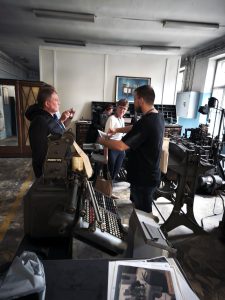
“I agree with Honza. They were interested in our production volume. They liked the 3D trimming samples. When I was showing them around, it was pouring rain—there was a thunderstorm and the power went out, so the machines weren’t running. So we spent some time in the ‘museum,’ where we talked about the history of the Prochaska Printing House. I explained to them how those old machines worked (the Monotype and the automatic typesetting machine). Many participants also expressed interest in a tour of FINIDR A,” added Miroslav Staszko.
A Piece of History Saved
Today’s FINIDR was founded in 1994, literally on a greenfield site. The historic Prochaska printing house building didn’t become part of it until much later.
When the company took it over in 2021, it wasn’t just about expanding its production facilities.
“We believe we’ve managed to preserve a significant part of the printing history of the Cieszyn region,” says Ondřej Prokop. “When you walk through the city center and look at the fate of some of the historic buildings, you realize that things could have turned out much worse.”
Prochaska’s printing house, however, was no ordinary business. Among other things, it printed for the imperial court of Franz Joseph I. It is said that this is where the emperor’s nickname, “Old Prochaska,” originated.
Today, part of the production still takes place in the historic building, and FINIDR employees work there. The building is thus not a museum, but a living part of the company.

A Place Worth Exploring
Visitor interest during ČteFesT showed that the history of printing and books still resonates strongly in the region.
“Many people knew that the printing house in the center of Cieszyn existed. But they’d never been inside,” says Ondřej Prokop. “At the end of the tour, they’re usually surprised by just how extensive the entire complex is.” Kateřina Misiarzová shares this view.
“People are clearly interested in what happened to the printing house, how it operates today, and what its history is. And at the same time, they’re interested in FINIDR. We have a lot to show.”
Perhaps that’s exactly why the tours during the festival were booked up so quickly.
It wasn’t just about the building.
It was about the chance to look behind the pages of a book—and to discover where its story actually began.