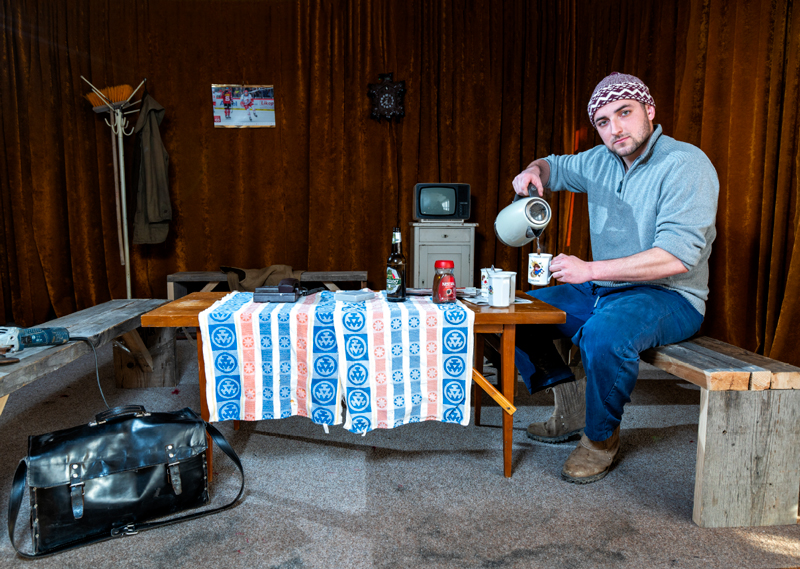
David Haratyk has only been with FINIDR for a year and a half, but outside of work, he does something completely different—writing and performing in plays that sell out cultural centers across the region. He is the author and one of the actors in the comedy *Ława*, inspired by the environment of the Třinec steelworks, regional humor, and stories that would otherwise remain “behind the scenes.” In the following interview, he reveals how an idea hatched over a beer turned into a successful play that entertains hundreds of people and, moreover, helps where it’s needed.
David, how did the idea to write a play even come about?
It came about completely spontaneously, as we were sharing all sorts of stories from family and friends who had worked at the Třinec steelworks for years. We were talking about what it was like there, and we came to the conclusion that without the “werk,” the region wouldn’t be what it is today. The steelworks has been rooted here for generations, and we all know how it goes—every now and then someone would moonlight outside their regular job, someone would take something out, do a little side gig… And at that moment, it occurred to me that this was the perfect foundation for a comedy full of exaggeration.
Having an idea is one thing but turning it into sold-out halls is another. What was the journey like?
We started at the Cultural Center in Milíkov, where we had four performances scheduled, all of which sold out immediately. It was such a success and people were asking for more dates that we decided to try continuing in the fall. We were invited to Jablunkov, and it sold out again. Then came the Rock Café in Jablunkov, where we went to play by invitation, and the interest was still so huge that we said to ourselves, let’s try to sell out the KD Trisia theatre hall. And we did it—five times! We had even planned for the possibility that only half the hall would fill up and that we’d have to cover the rental costs ourselves. The first date, December 14, 2025, was my idea, and after that, Trisia started offering us dates on their own.
How have your families reacted?
They didn’t know anything about the show. They were invited to the premiere. They had no idea what it would be about or what would happen. They basically went in blind. After the premiere, they were all thrilled. They support us, they’re understanding, and they come to see us again and again. They just live the success with us.
How long did it take to write the play?
About three months of intensive writing. An hour every day—from coming up with the main characters, through the entire plot, all the way to the conclusion. Then came the phase of gathering information and “inside scoops” from people who still work at the plant, so I could put the situations in context—how things really worked back then and still do today. I also spent about a year collecting wordplay jokes and regional sayings that people in our area came up with, which really brought the comedy to life.
Why is the play called Ława (Bench)?
Because when workers have a spare few minutes, they are laying on bench (ława)
Did you know right away that it wouldn’t just be a short skit?
Not at all. When I read the first draft aloud, it took almost an hour. It was originally supposed to be a twenty-minute skit that we’d perform at parties, but it was clear that it could turn into a full-length feature-length show.
David, how did you put the team together?
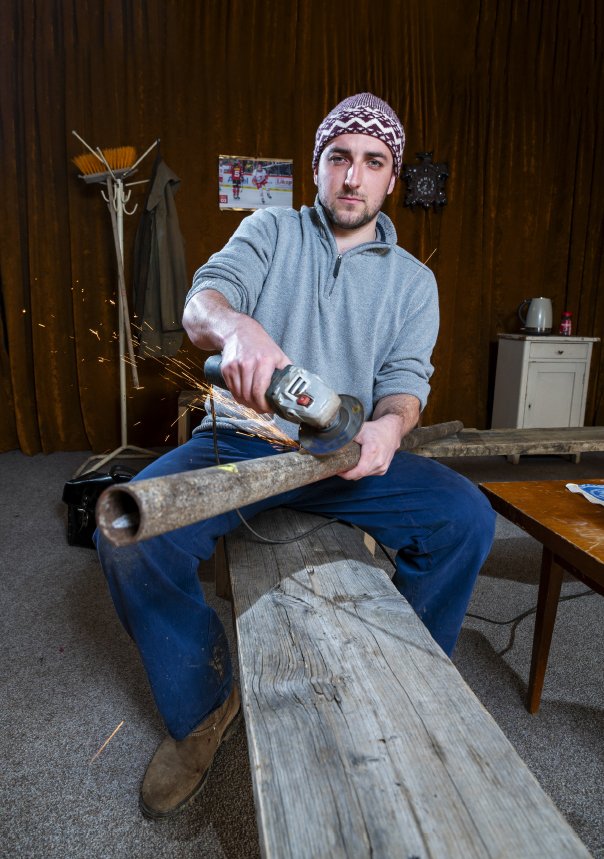
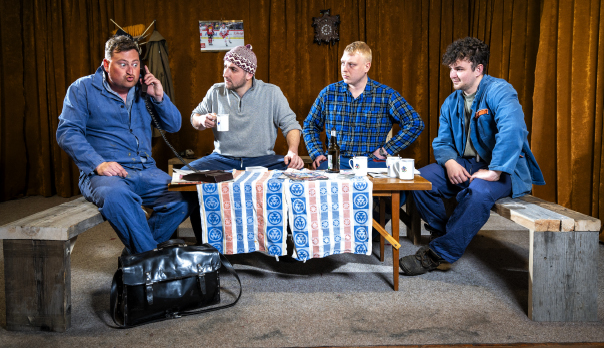
We’ve been doing theatre in Milíkov for a long time; there’s an amateur theatre group there under the auspices of PZKO, and they made this possible for us—they provided the facilities and props. The team then came together from people who were willing and brave enough to take this on with me. We have four main roles—played by my brother, me, and two close friends—plus four supporting characters. A well-coordinated group.
How did the rehearsals go?
Before the premiere, we rehearsed twice a week. We were constantly fine-tuning and making adjustments… We had the opportunity to perform the first show at the Milíkov Cultural Center last Easter, and about a hundred people saw it. The response was fantastic.
What is “Ława” actually about?
It depicts an entire morning shift at the factory — from clocking in to the bus ride back home. When I describe it sounds technical, but it’s actually pure comedy. People laugh from start to finish.
Don’t you feel like laughing while you’re performing?
I do. Sometimes really badly. Sometimes I have to turn my back to the audience to keep it together.
Is a sequel already in the works?
Yes, I’ve already finished the script. It’s called “Ablez – prosto z Ławy,” and it will once again focus on the everyday struggles of the ordinary workers at Werk. The premiere will be around Easter. We’d like to perform at Trisia again in the fall.
Were there any complications – I mean, did the situation in question get named and end up directly on stage?
It’s important to note that the story is exaggerated, even over-the-top, to entertain the audience. The plot takes place twenty years ago; it doesn’t reflect current reality, and the situations are no longer realistic.
You mentioned that you decided to donate the proceeds to a good cause—could you tell us more about that?
We’ve been doing well. We didn’t expect the play to be such a success. We never did this for the money. And since we’ve been lucky, we decided to help those who haven’t been so fortunate.
We’re donating the proceeds from the last two February performances to two people:
Dr. Zuzana Klusová
from the Třinec ambulance service, a mother of two young children who is battling cancer and continues to help save lives even during her treatment. We’ve decided to help cover her medical expenses; she’ll receive 75,000 CZK, which is the profit from the performance.
Dominika Martynek
from Dolní Lomná, a mother of three-year-old twins who fell into a vigil coma after suffering cardiac arrest in August 2025. Her family is trying to bring her home, and there is still hope that she will wake up.
David, it’s not just this achievement that’s admirable, but also the fact that at such a young age you’ve written your first play, delivered a brilliant performance in it, and sold out every show. It begs the question – aren’t you tempted by an acting career?
It’s a great hobby, but I’m not planning on becoming an actor, and I can’t even imagine doing it for a living.
Is it possible to balance theatre work with a job at FINIDR?
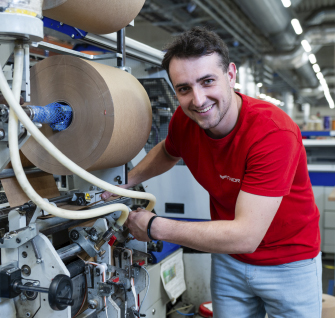
Well, I’m going to run out of my vacation soon… I’ve been at FINIDR for a year and a half, and I’ve been in the Finidr A from the start. Last year I was still an operator on the binding line, but since the new year I’ve been training on LIN6. On the binding line, you work with the final product, so I feel there’s more responsibility, whereas working on Line 6 is also interesting, but it’s a different kind of work. That’s where the product that goes to the binding line is actually manufactured. Because I have experiences from the binding line, I know what a product from LIN6 should look like. My experience from the binding line definitely comes in handy there. Every workstation has its own. Thanks to the fact that there’s a team of permanent employees here—and they’re great—the training was always friendly. There’s a welcoming atmosphere here; I don’t even have to worry about a language barrier with the Poles or Filipinos, so it’s all good.
David, what were your beginnings like after school?
After graduating from the technical high school in Karviná with a major in mechanical engineering, I joined a friend who owns a small construction company when I was 19. Together, we built houses and carried out complete building renovations. I learned a lot.
With your busy schedule, do you have time for any other hobbies?
I enjoy hiking—literally anywhere, whether in the Beskydy Mountains or the Alps. I joined the last three seasons of the B7. I also play hockey in the Silesian League for HC Kozubová and in the Beskydy Amateur Hockey League for HC Hrádek. Both leagues are amateur, and games are often played late in the evening, so this hobby is also very time-consuming.
David, you have an unusually diverse range of activities, and I hope this energy and joy last as long as possible and that things go well for you not only on stage but also in life. Thank you for the interview.
Thank you as well, and I wish all my colleagues the best of luck. And for those who missed the first performance of Ława, I’d love to invite everyone to the second one.
David Haratyk
Team Operator in production
What do I value most in my coworkers?
Their willingness to help and offer advice
Writing or acting?
Writing
The hardest moment on stage?
Not starting to laugh when something doesn’t go according to plan
The audience’s laughter or the applause at the end?
Both – the audience’s immediate reactions during the performance, spontaneous bursts of laughter, but also the applause at the end of the show
What drives you forward?
Enthusiasm and positive reactions – I can now say a few thousand audience members have seen the comedy – and, last but not least, helping financially those who are struggling with misfortune… I can’t do more than that